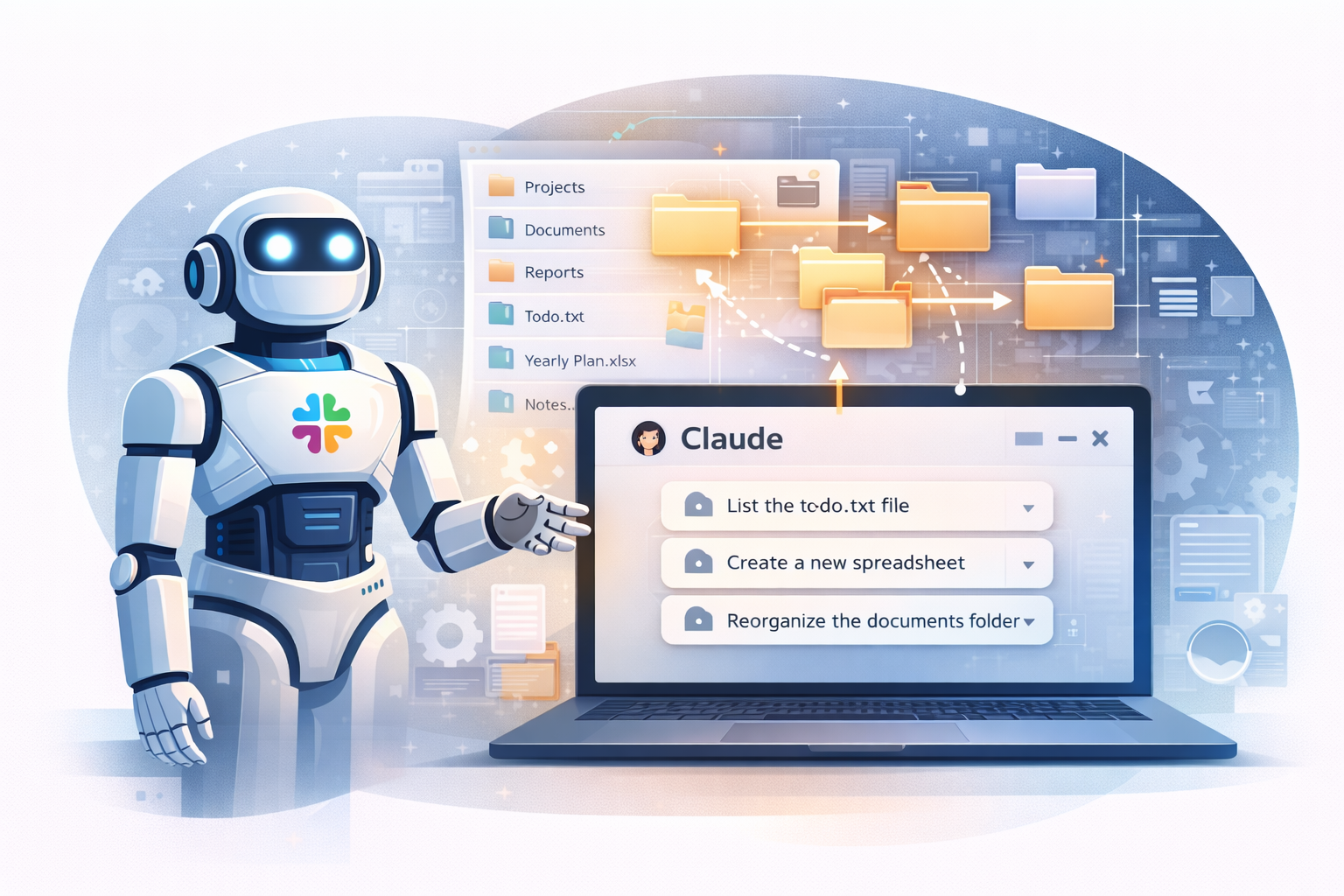
While most AI automation requires technical expertise, Anthropic’s new Cowork feature is essentially “Claude Code for everyone”: an agentic desktop mode inside Claude app that lets Claude read, create, and reorganize files in chosen folder without any terminal, SDK, or coding setup needed through accessible desktop AI agent. This isn’t just simplified developer tool, it’s fundamental democratization of AI automation through comprehensive desktop AI agent.
Here’s what separates AI automation democratizers from AI automation gatekeepers: while your competitors require technical configuration, Anthropic weaponized desktop AI agent through Cowork where you just point at specific folder it can read and modify, then describe outcome in chat without CLI or dev environment through intuitive desktop AI agent.
The result? Claude can open files, edit them, create new documents, and reorganize directory structures while running multi-step tasks in sequence or parallel without constant prompts, proving that desktop AI agent doesn’t just assist technical users, it enables everyone to automate through systematic desktop AI agent.
The Desktop AI Agent Revolution That’s Redefining Productivity Automation
When Anthropic launches agentic desktop mode that extends Claude Code’s capabilities to general non-coding work, they’re not just adding features, they’re fundamentally democratizing AI automation previously limited to developers through strategic desktop AI agent.
The scope of desktop AI agent becomes evident through Cowork operating as “research preview” initially available to Claude Max subscribers with waitlist for other plans, showing controlled rollout through early desktop AI agent.
Anthropic’s approach to desktop AI agent focuses on behaving like “persistent coworker that plans and executes tasks over time inside your file system” rather than prompt-by-prompt chat through autonomous desktop AI agent.
The transformation proves that desktop AI agent isn’t incremental chat improvement, it’s paradigm shift enabling AI to independently manage files and execute complex workflows through revolutionary desktop AI agent.
How Natural Language Replaces Technical Configuration In Desktop AI Agent
Most AI automation requires terminal access and development knowledge, while Anthropic transformed accessibility through desktop AI agent where users describe outcomes in chat rather than writing code or configuring environments through accessible desktop AI agent.
The power of Anthropic’s desktop AI agent becomes evident through sandboxed folder approach where Claude can read and modify files within chosen directory without requiring SDK setup through simplified desktop AI agent.
Their approach to desktop AI agent includes chat-based interface that accepts natural language task descriptions instead of technical commands or scripts through intuitive desktop AI agent.
When your desktop AI agent eliminates technical barriers by accepting plain English instructions, you enable non-technical users to automate workflows previously requiring programming through democratized desktop AI agent implementation.
The Agentic Task Execution That Desktop AI Agent Provides
Perhaps the most significant capability of Anthropic’s desktop AI agent is running long multi-step tasks, breaking them into subtasks, and executing them in sequence or parallel without constant user prompts through autonomous desktop AI agent.
This agentic behavior in desktop AI agent demonstrates how AI can plan and execute complex workflows independently rather than requiring step-by-step human direction through intelligent desktop AI agent.
Cowork’s desktop AI agent proves that automation can handle sophisticated file operations including reading, creating, editing, and reorganizing while providing progress updates through capable desktop AI agent.
The organizations enabling agentic desktop AI agent will achieve productivity automation that prompt-by-prompt chat tools cannot deliver through autonomous desktop AI agent.
The Use Case Diversity Within Desktop AI Agent
The practical applications of Anthropic’s desktop AI agent include renaming and sorting messy file collections, extracting data from receipt images into spreadsheets, and drafting reports from scattered notes through versatile desktop AI agent.
This use case breadth in desktop AI agent demonstrates that file automation serves diverse needs from organization to data extraction to document creation through multi-purpose desktop AI agent.
Their desktop AI agent approach includes handling typical workflows that non-technical users face daily without requiring coding skills through practical desktop AI agent.
When your desktop AI agent can organize files, extract data, and draft documents through natural language, you address common productivity challenges through comprehensive desktop AI agent.
The Persistent Context That Desktop AI Agent Maintains
The operational difference of Anthropic’s desktop AI agent is maintaining persistent context and state versus standard Claude chat that operates prompt-by-prompt with limited memory through stateful desktop AI agent.
This persistence in desktop AI agent enables Claude to behave like actual coworker who remembers ongoing projects and executes long-running tasks through continuous desktop AI agent.
Cowork’s desktop AI agent proves that productivity automation requires maintaining context across multiple operations rather than treating each interaction independently through persistent desktop AI agent.
The context maintenance in desktop AI agent creates workflow continuity that enables complex multi-step automation through connected desktop AI agent.
The Safety Architecture Within Desktop AI Agent
The security dimension of Anthropic’s desktop AI agent includes access scoped to chosen folder that constrains what Cowork can read or change, creating sandbox protection through bounded desktop AI agent.
This sandboxing in desktop AI agent demonstrates that AI file automation requires access controls preventing unrestricted system modifications through protected desktop AI agent.
Their desktop AI agent includes explicit warnings about risks like prompt injection and accidental deletions, recommending clear instructions and maintaining backups through cautious desktop AI agent.
When your desktop AI agent can modify or delete files within sandbox, users must understand risks and take appropriate precautions through responsible desktop AI agent.
The Non-Technical User Focus Of Desktop AI Agent
The strategic positioning of Anthropic’s desktop AI agent targets non-technical users who would not touch terminal but still want Claude Code-style automation through accessible desktop AI agent.
This accessibility focus in desktop AI agent demonstrates that Anthropic recognizes substantial market beyond developers who need file automation without requiring technical expertise through democratized desktop AI agent.
Cowork’s desktop AI agent proves that powerful automation doesn’t require programming knowledge when natural language interface handles technical complexity through simplified desktop AI agent.
The non-technical targeting of desktop AI agent expands potential user base dramatically compared to developer-focused automation tools through inclusive desktop AI agent.
The Desktop Integration Strategy In Desktop AI Agent
The platform approach of Anthropic’s desktop AI agent involves building into Claude Desktop app for macOS rather than web-based or mobile interface through native desktop AI agent.
This desktop integration in desktop AI agent demonstrates that file automation requires native system access that browser-based tools cannot provide through integrated desktop AI agent.
Their desktop AI agent approach of macOS-first launch suggests that desktop file automation represents strategic priority justifying platform-specific development through prioritized desktop AI agent.
When your desktop AI agent integrates natively with operating system, you enable file operations that web applications cannot match through system-level desktop AI agent.
The Competitive Implications Of Desktop AI Agent
The market impact of Anthropic’s desktop AI agent includes potentially threatening startups focused on AI file management and automation by incorporating capabilities into mainstream product through disruptive desktop AI agent.
This competitive pressure from desktop AI agent demonstrates how AI platform companies can subsume point solutions by building functionality directly into general-purpose tools through consolidating desktop AI agent.
Cowork’s desktop AI agent proves that Anthropic competes not just with other chatbots but with specialized automation tools through expanding desktop AI agent.
The startup disruption from desktop AI agent raises questions about defensibility of single-purpose AI tools when platforms incorporate similar capabilities through threatening desktop AI agent.
The Research Preview Status Of Desktop AI Agent
The rollout approach for Anthropic’s desktop AI agent involves “research preview” designation and waitlist access showing careful controlled deployment through staged desktop AI agent.
This preview status in desktop AI agent demonstrates that Anthropic approaches file automation cautiously given risks of system modifications through conservative desktop AI agent.
Their desktop AI agent includes limiting initial access to Claude Max subscribers while gathering feedback before broader release through restricted desktop AI agent.
When your desktop AI agent operates in research preview, you signal ongoing development while managing risks through experimental desktop AI agent.
The Long-Term Vision For Desktop AI Agent
The future trajectory of Anthropic’s desktop AI agent suggests evolution from file operations toward comprehensive desktop automation handling diverse system tasks through expanding desktop AI agent.
This vision for desktop AI agent demonstrates that Cowork represents foundation for broader desktop AI integration beyond just file management through foundational desktop AI agent.
Their desktop AI agent approach of launching specific use case while signaling broader ambitions shows strategic patience through evolving desktop AI agent.
The desktop automation potential from desktop AI agent extends to calendar management, email organization, and system configuration once file operations prove successful through growing desktop AI agent.
The Strategic Implementation Lessons From Desktop AI Agent
Anthropic’s desktop AI agent launch provides crucial insights for AI companies considering productivity automation. First, eliminate technical barriers by accepting natural language instructions rather than requiring code or configuration through accessible desktop AI agent.
Second, implement sandboxing that constrains AI access to specific folders protecting broader system from unintended modifications through safe desktop AI agent.
Third, target non-technical users who need automation but lack programming skills to expand market beyond developers through inclusive desktop AI agent.
Fourth, maintain persistent context enabling long-running multi-step tasks rather than just responding to individual prompts through stateful desktop AI agent.
The Future Belongs To Desktop AI Agent Leaders
Your productivity software company’s automation transformation is approaching through desktop AI agent technology that will define user empowerment. The question is whether your organization will democratize AI automation or maintain technical barriers limiting adoption.
Desktop AI agent isn’t just about file management, it’s about strategic productivity transformation that enables everyone to automate workflows through natural language interfaces that eliminate technical complexity while maintaining appropriate safety through capabilities that bring developer-level automation to non-technical users.
The time for strategic desktop AI agent development is now as Anthropic demonstrates that agentic file automation works for general users beyond developers. The organizations that eliminate technical barriers while maintaining safety will dominate desktop productivity while competitors require programming expertise that limits market size.
Anthropic proved through Cowork that comprehensive desktop AI agent works by bringing Claude Code capabilities to everyone through natural language file automation with sandboxed security. The only question remaining is whether your AI company has vision to democratize automation through desktop AI agent before competitors establish insurmountable adoption advantages by serving non-technical users that traditional automation tools ignore.