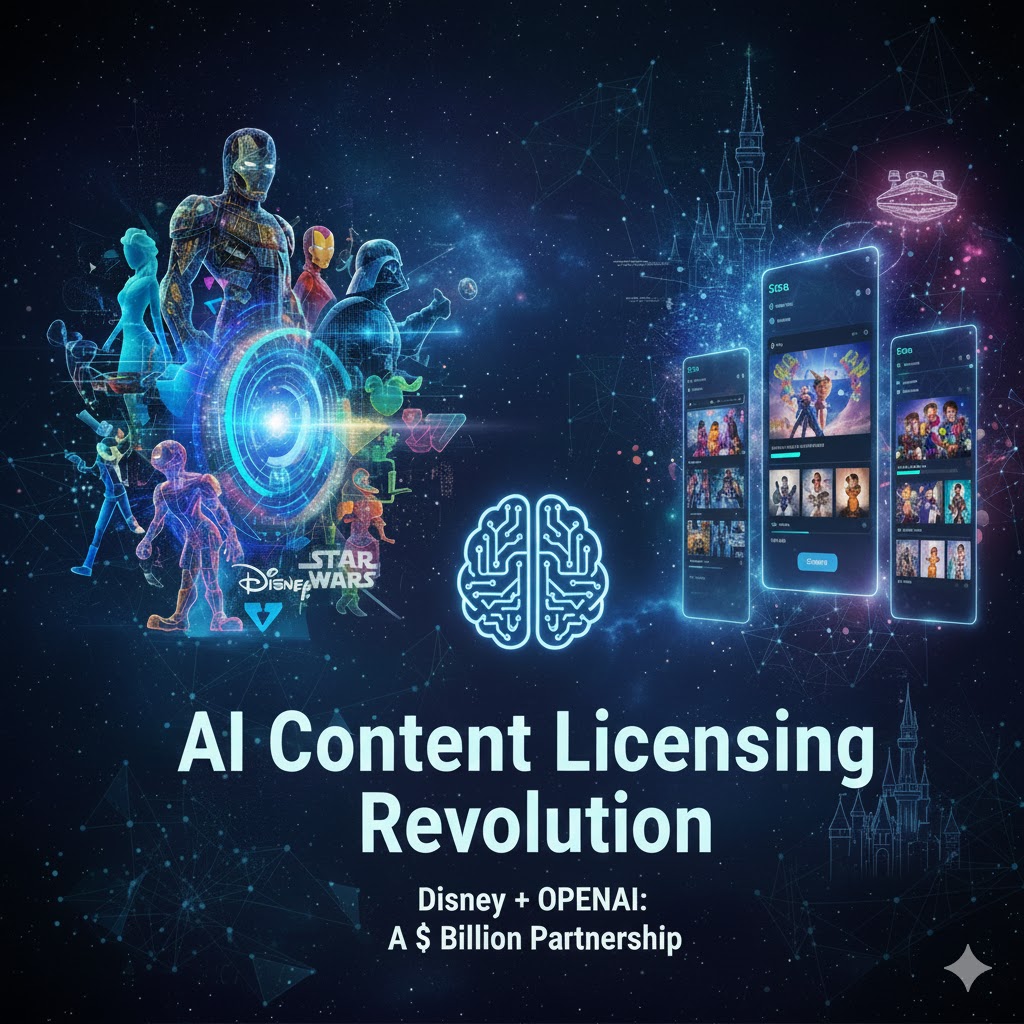
While most entertainment companies fight unauthorized AI use of their intellectual property, Disney and OpenAI announced three-year, billion-dollar partnership that lets Sora and ChatGPT create short AI-generated videos and images featuring hundreds of official Disney characters starting in early 2026 through strategic AI content licensing. This isn’t just technology licensing, it’s complete transformation of how entertainment IP monetization works through comprehensive AI content licensing.
Here’s what separates IP winners from IP losers: while your competitors sue to prevent AI use of their characters, Disney weaponized AI content licensing through investment of approximately $1 billion in OpenAI while becoming first major content-licensing partner on Sora through systematic AI content licensing.
The result? Agreement covering more than 200 characters from Disney, Pixar, Marvel, and Star Wars plus associated costumes, props, vehicles, and environments that enables fans to generate videos featuring Mickey Mouse, Iron Man, Darth Vader, and others within Disney’s usage rules, proving that AI content licensing doesn’t just protect IP, it creates new monetization through strategic AI content licensing.
The AI Content Licensing Revolution That’s Redefining Entertainment IP Management
When an entertainment leader like Disney invests $1 billion in OpenAI while licensing characters for generative AI use, they’re not just experimenting with technology, they’re fundamentally transforming how studios approach intellectual property and fan engagement through strategic AI content licensing.
Disney’s approach to AI content licensing focuses on becoming first major studio to establish authorized pathway for AI-generated character content rather than only pursuing infringement through progressive AI content licensing.
Their success with AI content licensing demonstrates how partnership with leading AI platform creates controlled environment for fan creativity while protecting IP value through managed AI content licensing.
The transformation proves that AI content licensing isn’t just defensive strategy, it’s proactive monetization opportunity that creates new revenue streams through systematic AI content licensing implementation.
How Smart Studios Turn IP Control Into Revenue Through AI Content Licensing
Most entertainment companies view AI-generated content as threat to intellectual property, while Disney transformed potential conflict into partnership opportunity through AI content licensing that enables authorized use while maintaining control.
The power of Disney’s AI content licensing becomes evident through three-year agreement that provides legal path for fans to create content featuring beloved characters within studio-defined parameters through structured AI content licensing.
Their approach to AI content licensing includes more than 200 characters from Disney, Pixar, Marvel, and Star Wars franchises, demonstrating comprehensive portfolio monetization through extensive AI content licensing.
When your AI content licensing can monetize fan creativity while maintaining brand standards, you achieve engagement and revenue that prohibition cannot deliver through innovative AI content licensing implementation.
The Fan Engagement That AI Content Licensing Enables
Perhaps the most significant transformation in Disney’s AI content licensing is enabling people to type prompts in Sora or ChatGPT Images to get short videos or visuals that legally use Disney IPs through authorized AI content licensing.
This fan empowerment through AI content licensing fundamentally changes relationship between studios and audiences by enabling authorized creativity rather than forcing underground unauthorized content through participatory AI content licensing.
Disney’s AI content licensing demonstrates how controlled fan content creation can enhance rather than threaten IP value when properly managed through strategic AI content licensing.
The organizations that implement fan-friendly AI content licensing will dominate engagement while competitors struggle with infringement battles that alienate audiences through collaborative AI content licensing.
The Platform Integration That AI Content Licensing Creates
Disney’s AI content licensing includes curated selection of standout Sora-generated Disney clips expected to appear on Disney+ once experience launches, demonstrating platform integration through distributed AI content licensing.
This platform strategy through AI content licensing ensures that best fan-created content amplifies Disney+ value while showcasing AI capabilities through featured AI content licensing.
Their AI content licensing approach includes plans to use OpenAI’s APIs and ChatGPT internally to build new products, tools, and personalized experiences for Disney+ through integrated AI content licensing.
When your AI content licensing can enhance streaming platform value while enabling fan creativity, you achieve dual benefits through strategic AI content licensing.
The IP Protection That AI Content Licensing Maintains
The critical balance in Disney’s AI content licensing is agreement that does not include actor likenesses or voices, ensuring generated content uses stylized or animated versions rather than real-world talent performances through protected AI content licensing.
This protection approach through AI content licensing addresses talent concerns while enabling character use, creating sustainable model that respects all stakeholders through ethical AI content licensing.
Disney’s AI content licensing demonstrates how studios can embrace generative AI while maintaining boundaries that protect talent rights through responsible AI content licensing.
The protection mechanisms in AI content licensing become increasingly important as technology capabilities advance and stakeholder concerns evolve through governed AI content licensing.
The Industry Leadership That AI Content Licensing Establishes
Disney’s AI content licensing positions them as first major studio to embrace licensed generative AI content, establishing leadership that influences how entertainment industry approaches AI through pioneering AI content licensing.
This leadership through AI content licensing signals broader industry acceptance of authorized AI content generation as legitimate business model rather than threat requiring prohibition through transformative AI content licensing.
Their AI content licensing success enables market positioning around innovation and fan engagement that differentiates from competitors pursuing only defensive strategies through forward-looking AI content licensing.
The market leadership established through AI content licensing influences investor perception and brand value beyond immediate licensing revenue through pioneering AI content licensing.
The Equity Investment That AI Content Licensing Includes
Disney’s AI content licensing includes equity stake in OpenAI that provides financial upside from AI platform growth beyond just licensing fees through strategic AI content licensing.
This equity component of AI content licensing aligns Disney’s interests with OpenAI’s success while providing returns on technology investment through participatory AI content licensing.
Their AI content licensing demonstrates how strategic partnerships can create multiple value streams including licensing revenue, platform integration, and equity appreciation through comprehensive AI content licensing.
When your AI content licensing includes equity participation, you achieve financial benefits that extend beyond direct licensing through investment-focused AI content licensing.
The Usage Rules That AI Content Licensing Enforces
The governance structure of Disney’s AI content licensing includes Disney’s usage rules that control how characters can be depicted, ensuring brand protection while enabling creativity through managed AI content licensing.
This rule framework through AI content licensing balances fan freedom with brand standards, creating sustainable model that protects IP value through structured AI content licensing.
Disney’s AI content licensing proves that controlled access generates more value than prohibition when governance ensures appropriate use through governed AI content licensing.
The usage controls in AI content licensing become critical success factors as scale increases and diverse creators generate content through monitored AI content licensing.
The Competitive Moat That AI Content Licensing Creates
Disney’s AI content licensing creates competitive advantages through exclusive three-year partnership that prevents competitors from accessing Disney characters through similar arrangements during term through protected AI content licensing.
This exclusivity through AI content licensing strengthens OpenAI’s platform differentiation while ensuring Disney captures value from AI-generated character content through strategic AI content licensing.
Their AI content licensing demonstrates how first-mover advantages in AI partnerships create barriers to competitive entry through exclusive AI content licensing.
The competitive protection from AI content licensing compounds over time as Disney-OpenAI integration deepens and competitor alternatives remain limited through exclusive AI content licensing.
The Internal Transformation That AI Content Licensing Supports
Disney’s AI content licensing includes plans to use OpenAI APIs and ChatGPT internally for building new products and personalized experiences, extending benefits beyond external fan use through operational AI content licensing.
This internal application of AI content licensing demonstrates how partnerships can transform both external monetization and internal operations through comprehensive AI content licensing.
Their AI content licensing proves that strategic technology partnerships should enhance multiple business areas rather than serving single purpose through integrated AI content licensing.
When your AI content licensing can improve both customer experiences and internal operations, you achieve comprehensive value through holistic AI content licensing.
The Industry Signal That AI Content Licensing Sends
The strategic importance of Disney’s AI content licensing is tougher stance against unlicensed AI use of IP by drawing clear line between authorized and unauthorized generative content through definitive AI content licensing.
This positioning through AI content licensing establishes framework for pursuing infringement while promoting legitimate use, creating sustainable approach to AI and IP through balanced AI content licensing.
Disney’s AI content licensing demonstrates how studios can embrace AI opportunity while protecting property rights through strategic AI content licensing.
The industry influence of AI content licensing extends beyond Disney to shape how all entertainment companies approach AI and intellectual property through precedent-setting AI content licensing.
The Strategic Implementation Lessons That Define AI Content Licensing Success
Disney’s AI content licensing transformation provides crucial insights for entertainment companies considering AI partnerships. First, establish authorized pathways for fan creativity rather than only pursuing prohibition through enabling AI content licensing.
Second, include equity participation in AI platforms that aligns interests and provides financial upside beyond licensing fees through investment-focused AI content licensing.
Third, implement usage rules that balance fan freedom with brand protection to ensure sustainable value creation through governed AI content licensing.
Fourth, integrate AI capabilities internally to enhance operations and products beyond just external licensing through comprehensive AI content licensing.
The Future Belongs To AI Content Licensing Leaders
Your entertainment company’s IP transformation is approaching through AI content licensing technology that will define competitive advantage for studios willing to embrace authorized generative content. The question is whether your organization will develop comprehensive AI content licensing capabilities or struggle with infringement battles.
AI content licensing isn’t about technology alone, it’s about strategic IP management that transforms how entertainment companies monetize characters, engage fans, and compete in AI-enabled markets through capabilities that create new revenue streams.
The time for strategic AI content licensing implementation is now. The organizations that act decisively will establish market positions and licensing frameworks that become increasingly difficult for competitors to challenge as AI content licensing matures and fan expectations evolve.
Disney proved that comprehensive AI content licensing works at massive scale with $1 billion investment while establishing authorized pathway for fan-created character content. The only question remaining is whether your executive team has the vision to implement systematic AI content licensing before competitors establish exclusive partnerships that limit your options in generative content markets.