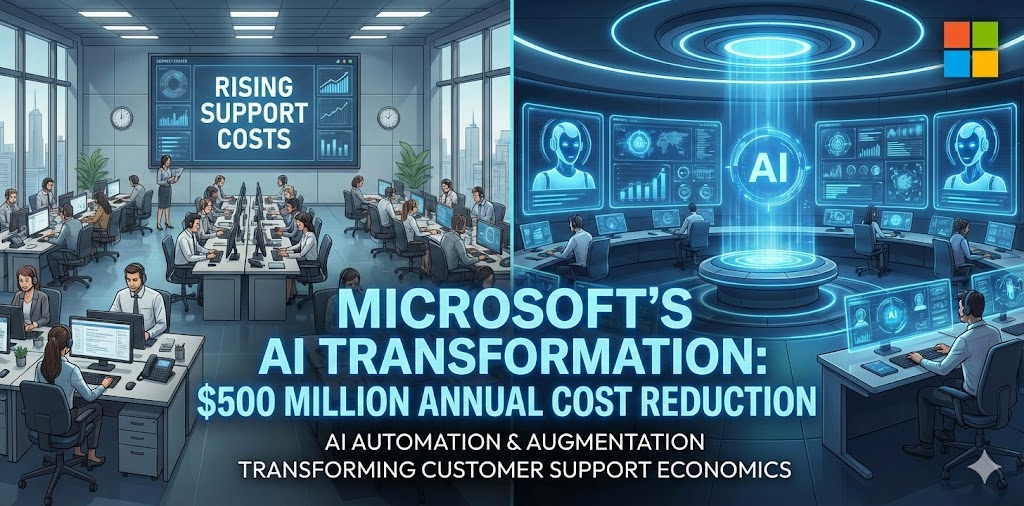
While most enterprises struggle with rising support costs and declining service quality, Microsoft claims it cut more than $500 million in annual costs by using AI to automate and augment work in contact centers and related support operations through systematic AI cost reduction. This isn’t just operational improvement, it’s complete transformation of customer support economics through strategic AI cost reduction.
Here’s what separates cost management winners from cost management losers: while your competitors hire more support staff to handle growing volumes, Microsoft weaponized AI cost reduction through chatbots and virtual agents that handle routine customer inquiries while AI tools summarize cases, draft responses, and assist agents in real time through comprehensive AI cost reduction.
The result? Case review time dropped from around half an hour to just a few minutes, first-call resolution increased by 31%, and AI-assisted agents handle 10% to 15% more cases, proving that AI cost reduction doesn’t just lower expenses, it improves service quality through systematic AI cost reduction implementation.
The AI Cost Reduction Revolution That’s Redefining Enterprise Support
When a technology leader like Microsoft deploys AI systems in call centers that save over $500 million in a single year, they’re not just reducing costs, they’re fundamentally transforming how enterprises approach customer support and operational efficiency through strategic AI cost reduction.
Microsoft’s approach to AI cost reduction focuses on automating high-volume, repetitive interactions first with chatbots and AI agents handling Tier-1 support, FAQs, and simple account tasks that previously required human intervention through targeted AI cost reduction.
Their success with AI cost reduction demonstrates how AI tools can increase first-call resolution and lower handling time, enabling the same or smaller team to process more cases while maintaining or improving service quality through intelligent AI cost reduction.
The transformation proves that AI cost reduction isn’t just about cutting expenses, it’s about creating entirely new operational capabilities that improve both cost structure and service delivery through systematic AI cost reduction implementation.
How Smart Companies Turn Support Operations Into Cost Savings Through AI Cost Reduction
Most enterprises accept growing support costs as inevitable consequence of business growth, while Microsoft transformed customer support into major cost savings opportunity through AI cost reduction that eliminates labor-intensive processes while improving outcomes.
The power of Microsoft’s AI cost reduction becomes evident through the quantified savings from customer support and contact centers, with spillover into sales and engineering that demonstrates comprehensive AI cost reduction impact.
Their approach to AI cost reduction includes AI tools that summarize and route cases, draft responses, surface knowledge articles, and assist agents in real time, reducing manual effort while accelerating resolution through optimized AI cost reduction.
When your AI cost reduction can handle routine inquiries automatically while augmenting human agents for complex issues, you achieve cost savings and quality improvements simultaneously through comprehensive AI cost reduction implementation.
The Copilot Strategy That Amplifies AI Cost Reduction
Perhaps the most significant aspect of Microsoft’s AI cost reduction is using AI as “copilot” for remaining staff through summarization, suggested replies, next-best actions, and knowledge search rather than just full automation through strategic AI cost reduction.
This copilot approach to AI cost reduction fundamentally changes support agent productivity by providing real-time assistance that enables faster, more accurate responses while reducing training requirements through augmented AI cost reduction.
Microsoft’s AI cost reduction includes tools that help sales and engineering by generating code and handling smaller customer accounts at scale, framing these as “productivity gains” that translate into internal cost savings through comprehensive AI cost reduction.
The organizations that implement copilot-style AI cost reduction will dominate support efficiency while competitors struggle with pure automation that cannot handle complex cases or full manual operations that cannot compete on cost.
The Performance Metrics That Demonstrate AI Cost Reduction Value
Microsoft’s AI cost reduction delivers measurable performance improvements including case review time dropping from around half an hour per case to just a few minutes thanks to auto-summaries and knowledge retrieval through efficient AI cost reduction.
The operational gains from AI cost reduction include first-call resolution increasing by roughly 31%, missed routes falling about 20%, and AI-assisted agents handling around 10% to 15% more cases through optimized AI cost reduction.
Their approach to AI cost reduction extends beyond support to software development where AI now generates roughly a third of new product code, accelerating delivery while supporting the cost-savings narrative through comprehensive AI cost reduction.
When your AI cost reduction can improve resolution rates, reduce handling time, and increase agent capacity simultaneously, you achieve operational transformation that creates sustainable competitive advantages through systematic AI cost reduction.
The Infrastructure Investment That Enables AI Cost Reduction
The context of Microsoft’s AI cost reduction includes $80 billion in data center and AI infrastructure capex investment that enables the automation capabilities generating the savings through strategic AI cost reduction.
This infrastructure investment for AI cost reduction demonstrates how significant upfront capital investment can generate substantial ongoing operational savings that justify the technology spending through calculated AI cost reduction.
Microsoft’s AI cost reduction strategy shows how technology leaders invest heavily in AI infrastructure while generating immediate cost savings that partially offset the capital expenditure through balanced AI cost reduction.
The infrastructure requirements for AI cost reduction mean that successful implementation requires both technical capability and financial resources that smaller organizations may struggle to match through comprehensive AI cost reduction.
The Workforce Implications Of AI Cost Reduction
The most controversial aspect of Microsoft’s AI cost reduction is that savings coincided with layoffs of several thousand roles, suggesting that substantial part of the $500 million figure represents labor replaced or not rehired through workforce AI cost reduction.
This workforce dimension of AI cost reduction raises social and ethical questions about what happens to displaced workers and how much of the savings are reinvested versus flowing straight to margins and AI infrastructure through concerning AI cost reduction.
Their AI cost reduction demonstrates how automation benefits often come at cost of job elimination rather than pure efficiency gains, creating tension between business objectives and social responsibility through workforce AI cost reduction.
The employment impact of AI cost reduction will increasingly influence public perception and regulatory response as more companies implement automation that displaces human workers through controversial AI cost reduction.
The Automation Priority Strategy In AI Cost Reduction
Microsoft’s AI cost reduction focuses on automating high-volume, repetitive interactions first including Tier-1 support, FAQs, and simple account tasks with chatbots and AI agents that handle routine queries through prioritized AI cost reduction.
The automation strategy in their AI cost reduction targets the largest cost centers with most standardized processes first, generating immediate savings while building capabilities for more complex automation through strategic AI cost reduction.
Their approach to AI cost reduction demonstrates how successful automation begins with clear identification of highest-value opportunities rather than attempting to automate everything simultaneously through focused AI cost reduction.
When your AI cost reduction can target the largest cost pools with highest automation potential, you achieve maximum return on technology investment through prioritized AI cost reduction implementation.
The Metrics Tracking That Proves AI Cost Reduction
Microsoft’s AI cost reduction includes rigorous tracking of metrics like handle time, first-contact resolution, and cases per agent, then translating operational gains into clear annual dollar figures through measured AI cost reduction.
The measurement discipline in their AI cost reduction enables confident claims about $500 million savings because detailed tracking connects specific operational improvements to financial impact through documented AI cost reduction.
Their AI cost reduction demonstrates how successful automation requires comprehensive metrics that prove value rather than relying on anecdotal improvement claims through verified AI cost reduction.
The measurement capabilities for AI cost reduction become critical when justifying continued technology investment and demonstrating return on automation spending through proven AI cost reduction.
The Scalability Advantage Of AI Cost Reduction
Microsoft’s AI cost reduction demonstrates how automation creates scalable operations that can handle growing volumes without proportional cost increases through leveraged AI cost reduction.
The scalability benefits of AI cost reduction mean that as business grows, support costs increase more slowly than revenue, improving unit economics over time through efficient AI cost reduction.
Their approach to AI cost reduction shows how automation investment creates compound benefits as volume grows, with initial savings multiplying as business scales through scalable AI cost reduction.
When your AI cost reduction can improve unit economics while enabling growth without proportional cost increases, you achieve business model transformation through strategic AI cost reduction.
The Competitive Implications Of AI Cost Reduction
Microsoft’s AI cost reduction establishes them as technology leader while creating cost structure advantages that competitors struggle to match without similar automation capabilities through demonstrated AI cost reduction.
The comprehensive nature of their AI cost reduction, from contact centers to sales to engineering, creates integrated cost advantages across multiple business functions through systematic AI cost reduction.
Their AI cost reduction success enables more competitive pricing, higher margins, or increased reinvestment in product development compared to competitors with traditional cost structures through strategic AI cost reduction.
The market leadership established through AI cost reduction influences customer expectations and competitive dynamics as automation becomes standard expectation rather than differentiator through industry AI cost reduction.
The Strategic Implementation Lessons That Define AI Cost Reduction Success
Microsoft’s AI cost reduction transformation provides crucial insights for enterprises considering automation for cost management. First, prioritize high-volume, repetitive processes that offer largest immediate savings potential through focused AI cost reduction.
Second, implement copilot approaches that augment rather than replace workers for complex tasks, maximizing productivity while maintaining quality through balanced AI cost reduction.
Third, invest in comprehensive measurement systems that connect operational improvements to financial savings, enabling confident ROI claims through documented AI cost reduction.
Fourth, recognize that substantial AI cost reduction often involves workforce displacement, requiring thoughtful change management and social responsibility consideration through ethical AI cost reduction.
The Future Belongs To AI Cost Reduction Leaders
Your enterprise’s cost structure transformation is approaching through AI cost reduction technology that will define competitive advantage for organizations willing to invest in automation infrastructure. The question is whether your company will develop comprehensive AI cost reduction capabilities or struggle with rising costs that erode margins.
AI cost reduction isn’t about technology alone, it’s about strategic operations transformation that fundamentally changes unit economics and scalability through capabilities that create sustainable cost advantages.
The time for strategic AI cost reduction implementation is now. The organizations that act decisively will establish cost structures that become increasingly difficult for competitors to match as AI cost reduction capabilities mature and automation expectations evolve.
Microsoft proved that comprehensive AI cost reduction works at enterprise scale while delivering measurable financial benefits. The only question remaining is whether your executive team has the vision to implement systematic AI cost reduction before competitors make it their advantage in cost management and operational efficiency.